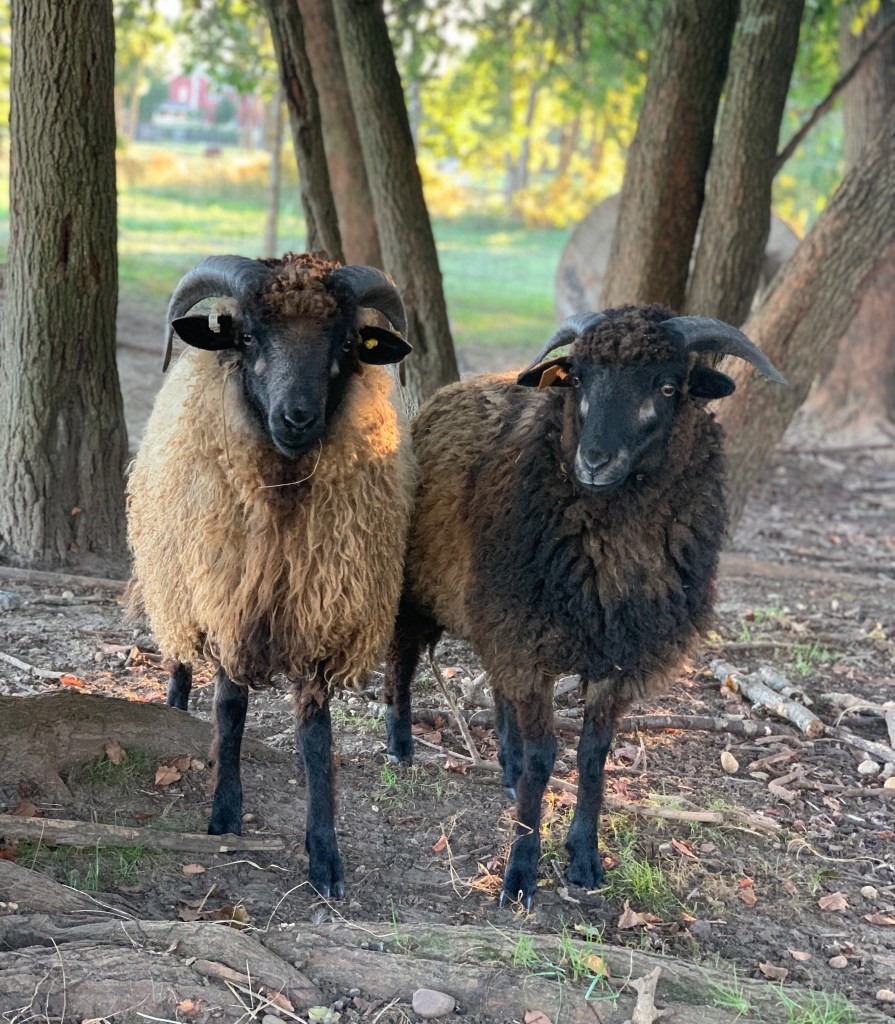
Here are our two lamb rams just one month after we traveled across the country to pick them up.
Meet Indi (short for Indiana) on the left and Colorado on the right—named after the states where we found them.
You’re probably thinking: “Wait… you drove 3,904 miles round-trip for sheep? That’s bananas.”
And honestly? You’re absolutely right.
But anything truly worth doing rarely comes easy. There’s a meaningful reason behind that journey.
We believe deeply in stewardship—of the land, of heritage breeds, and of every animal in our care. Bringing home these rams wasn’t just a road trip; it was an investment in preserving America’s oldest sheep breed and honoring the role they play in sustainable, holistic farming.
A Heritage Breed With a Legendary Past
Origins in Spain
The Navajo-Churro traces its ancestry to the Churra sheep of Spain — a hardy, dual-coated breed valued for meat, milk, and strong wool. These sheep were brought to the Americas during the Spanish conquests. In 1538, Hernán Cortés introduced Churra and Merino sheep to areas near Mexico City as a dependable source of food and fiber.
Arrival in the American Southwest
In 1540, the explorer Francisco Vásquez de Coronado led an expedition north in search of the mythical Seven Cities of Cibola. His party brought Churro sheep into what is now the American Southwest. When Coronado abandoned the expedition, these sheep were left behind with a mission priest in New Mexico, where they remained in use by local communities.
A major introduction followed in 1598, when Spanish colonizer Juan de Oñate established settlements along the upper Rio Grande Valley. His expedition brought thousands of sheep — Churro and Merino — establishing long-term herds that would shape the region’s pastoral economy.
Adoption by Indigenous Communities
Over the 1600s and 1700s, Indigenous peoples — especially the Diné (Navajo) — acquired sheep through trade, raids, and exchange with Spanish settlers.
The Navajo adopted these sheep not only for meat and milk, but especially for wool.
Over generations, selective breeding and adaptation to harsh desert landscapes produced what we now identify as the Navajo-Churro — a breed known for: long, lustrous, dual-coated fleece a wide range of natural colors hardiness and resistance to disease ability to thrive on sparse forage.
Churro wool became the foundation of Navajo weaving, one of the most respected textile traditions in North America.
Cultural Importance
For the Navajo, sheep hold deep cultural meaning. The Navajo-Churro is known as Dibé dits’ozí (“long-fleeced sheep”), and is tied to identity, spirituality, stories of creation, and the rhythm of daily life.
The wool of these sheep enabled the development of: rugs blankets ceremonial weavings clothing saddle blankets trade goods
The breed is inseparable from the history of Navajo artistry and survival.
Near Extinction
From the mid-1800s to the mid-1900s, the Navajo-Churro sheep — and by extension the culture, livelihood, and identity of the Diné (Navajo) people — were systematically targeted by U.S. government policies and military actions.
The destruction of livestock — especially the Churro flocks — was a deliberate act of cultural and economic warfare. With food, water, animals, and homes destroyed, the Navajo were forcibly removed from their lands. This campaign culminated in the forced deportation known as the Long Walk of the Navajo, in which thousands of Navajo people were marched hundreds of miles to internment at the Bosque Redondo Reservation (Fort Sumner, NM). Many died en route or during captivity, and their herds and flocks — the foundation of their livelihood — were largely lost.
The traditional Navajo-Churro — valued by the Diné for their hardy fleece and suitability to desert environment — were considered “scrub,” “unimproved,” or economically unproductive under government policy. They were often excluded from “approved” breeding programs, replaced or cross-bred with fine-wool sheep better suited for mass-market wool for large-scale textile mills. These pressures diluted the original Churro traits.
By the 1970s, fewer than 500 true Navajo-Churro remained.
Revival and Conservation
In the late 1970s, historian and livestock specialist Dr. Lyle McNeal founded the Navajo Sheep Project to recover remnant “old-type” Churro sheep. Surviving animals from Navajo families, Hispanic villages, and small isolated flocks were brought together to rebuild the breed.
In 1986, the Navajo-Churro Sheep Association (N-CSA) was established to set breed standards, support growers, and maintain registrations.
Today, due to decades of conservation work, the Navajo-Churro is no longer on the brink of extinction. It remains a heritage and recovering rare breed, protected through partnerships between Navajo families, ranchers, fiber artists, museums, and conservation organizations.
Why the Navajo-Churro Matters Today
The breed holds a unique place in modern agriculture:
Genetic diversity: One of North America’s oldest sheep breeds.
Cultural preservation: Central to Navajo weaving and Indigenous stewardship.
Sustainability: Thrives in low-input, regenerative, arid land systems.
Fiber arts: Produces world-renowned wool for traditional and modern textile work.
The Navajo-Churro sheep is not just livestock — it is a living piece of history, culture, and resilience.
The Navajo-Churro once numbered just over a million now are listed critically on the Livestock Conservation list with roughly 4,500 in population.
Our Mission
We choose this heritage breed because it’s the one that needs the most help, based on what you just read. Not only that, they are so beautiful, they are living rainbows. They come in so many colors/patterns, like a box of chocolates. Our goal is to help the population grow and promote the multi uses this wonderful breed has to offer.
References
The Navajo-Churro Sheep Association (N-CSA) – Breed history and standards
The Livestock Conservancy – Heritage breed profile: Navajo-Churro
.The Navajo Sheep Project – Historical recovery documentation.org/navajo-churro-history
Hestia’s Homestead LLC all rights reserved
Photography by Hestia’s Homestead LLC
 Hestia's Homestead